AI-Powered Development vs Manual Coding
How OpenSource Technologies Supports Both
Artificial Intelligence is rapidly changing the way software is built — including how AI software development services are delivered. AI-powered coding tools can now generate code, automate testing, and accelerate development cycles. At the same time, traditional manual coding continues to play a crucial role in building reliable, scalable, and secure software systems.
For businesses investing in technology, the question is no longer whether to use AI or manual coding — it’s about choosing the right development approach for each project. Some organizations want to fully embrace AI-assisted development; others prefer the precision and control of traditional software engineering.
At OpenSource Technologies (OST), we support both. By combining AI-powered development tools with experienced software engineers, we help businesses build powerful digital solutions while maintaining the flexibility to choose how those solutions are created.
The AI Coding Landscape: By The Numbers (2025–2026)
Sources: Stack Overflow Developer Survey 2025 | Second Talent Research | GitHub Industry Analysis
Understanding AI-Powered Development
AI-powered development refers to the use of artificial intelligence tools that assist developers in writing, testing, and optimizing code. Tools such as GitHub Copilot, Cursor, Claude Code, and machine learning-based automation platforms are transforming development workflows at every scale — and are central to what modern AI software development services are designed to deliver.
What AI Tools Do Well
- Generate and autocomplete code snippets across dozens of languages
- Automate repetitive programming tasks and boilerplate
- Detect bugs and security vulnerabilities at code-review speed
- Accelerate product prototyping and documentation
- Help new hires onboard to complex codebases — cutting onboarding time in half (DX Research, Q1 2026)
However, a broader picture reveals nuance. According to Stack Overflow’s 2025 Developer Survey of over 49,000 developers, positive sentiment for AI tools has declined from 70%+ in 2023–2024 to just 60% in 2025 — largely driven by concerns about accuracy and security. AI tools still require experienced engineers to guide the development process and ensure that generated code meets enterprise standards.
The Hidden Risks: AI Code Is Unregulated — and Often Unprotectable
Security vulnerabilities are not the only reason enterprises should approach AI-generated code with caution. Two deeper, structural challenges remain widely underappreciated: the absence of a mature regulatory framework governing AI-generated code, and the inability to claim copyright or trademark protection over code that AI writes without meaningful human authorship.
1. AI Development Still Operates in a Regulatory Grey Zone
As of 2026, there is no comprehensive federal law in the United States specifically governing the use of AI in software development. The EU AI Act — currently the world’s most advanced AI regulatory framework — began enforcing its General Purpose AI (GPAI) rules in August 2025, with full high-risk AI compliance deadlines extending into late 2026 and 2027. The global regulatory picture remains fragmented and fast-moving.
This regulatory vacuum creates real risk for businesses. When something goes wrong with AI-generated code — a security breach, a biased output, a faulty system — there is often no clear legal framework to determine accountability. Who is liable: the developer who used the AI tool, the organization that deployed it, or the tool vendor? Courts are only beginning to answer these questions, and answers vary significantly by jurisdiction.
At OpenSource Technologies, we believe that manually authored code — written by accountable engineers, reviewed through structured processes, and documented at every step — gives businesses the clearest path to defensibility in this unsettled legal environment.
2. AI-Generated Code Cannot Be Copyrighted or Trademarked
This is one of the most overlooked risks in AI-assisted development: if your software is written primarily by AI without meaningful human contribution, you may not be able to legally own it. Your core platform could be unprotectable — and freely copyable by competitors.
🔒 The Intellectual Property Problem with AI Code
→ The U.S. Copyright Office confirmed in January 2025 that works generated solely by AI, without meaningful human creativity, are NOT eligible for copyright protection.
→ The DC Circuit Court affirmed in March 2025 (upheld on rehearing in May 2025): purely AI-generated works cannot be copyrighted. Code with no copyright enters the public domain.
→ The USPTO rejects patent applications listing AI as sole inventor — inventorship must be a natural human person.
→ Harvard Law’s Prof. Rebecca Tushnet warned that AI’s role in trademark violations will require rethinking foundational trademark law — current frameworks were not built for AI-generated outputs (IAPP, 2025).
→ Even trade secret protection for AI-generated code is legally uncertain — the AI may have been trained on similar patterns already in the public domain (McDonnell Boehnen Hulbert, 2025).
→ The key legal distinction: AI-assisted code (human substantially directs and refines) can qualify for protection. AI-autonomous code (machine generates with minimal human input) typically cannot.
What this means practically: a competitor could replicate your platform’s AI-generated codebase without legal consequence. For businesses investing heavily in proprietary software as a competitive asset, this is a critical strategic risk.
✅ How OST Protects Your IP When Using AI Tools
→ All AI-assisted code at OST is reviewed, refined, and substantially modified by human engineers — establishing clear human authorship and copyright eligibility.
→ We document developer contributions at each stage, creating an audit trail that supports IP ownership claims.
→ For clients in IP-sensitive industries, we offer fully manual development — ensuring every line of code is human-authored, owned, and legally protectable.
→ We advise clients to maintain strict confidentiality practices around AI-assisted codebases to preserve trade secret protections where copyright may be limited.
Why Manual Coding Still Matters?
While AI is a powerful development assistant, manual coding remains essential for building production-grade software systems — particularly those subject to strict compliance, security, or architectural requirements.
When Manual Engineering Is Non-Negotiable
- Applications requiring complex, custom system architecture
- Systems operating under strict security, HIPAA, SOC2, GDPR, or regulatory compliance standards
- Software integrating deeply with legacy systems or proprietary APIs
- Performance-critical platforms where every millisecond matters
- Long-term codebases where technical debt and maintainability are strategic priorities
- Projects where IP ownership and copyright protectability of code are business-critical
- Environments where regulatory accountability and full code auditability are required
Human developers bring contextual understanding, architectural thinking, and problem-solving skills that AI tools cannot fully replicate. In fact, Google’s 2024 DORA report found that increased AI adoption speeds up documentation but causes a 7.2% decrease in delivery stability — a trade-off that many enterprise teams cannot accept.
Research from Faros AI analyzing 10,000+ developers across 1,255 teams found that AI adoption is consistently associated with a 9% increase in bugs per developer and a 154% increase in average pull request size — placing enormous pressure on code review and QA systems.
“AI excels at greenfield projects but struggles with complex legacy codebases.” — Stack Overflow Developer Survey, 2025
At OpenSource Technologies, our development teams specialize in writing high-quality, maintainable code using established engineering practices. For clients that require traditional development without AI-generated code, we deliver fully manual solutions with the same focus on scalability, security, and long-term performance.
Head-to-Head Comparison
| Dimension | Winner | Reason |
|---|---|---|
| Speed | 🤖 AI | Generates code far faster for common patterns |
| Accuracy | 👨💻 Manual | Developers are less likely to introduce subtle bugs |
| Learning | 👨💻 Manual | Writing code by hand deepens understanding |
| Scalability of Effort | 🤖 AI | One developer can accomplish far more |
| Security | 👨💻 Manual | Intentional code is safer than auto-generated code |
| Innovation | 👨💻 Manual | Novel system design requires human creativity |
| Accessibility | 🤖 AI | Lowers the bar for non-expert developers |
| Regulation & Code Ownership | 👨💻 Manual | AI-generated code lacks clear regulation, ownership standards, and may raise copyright concerns |
The Hybrid Development Model: The Best of Both Worlds
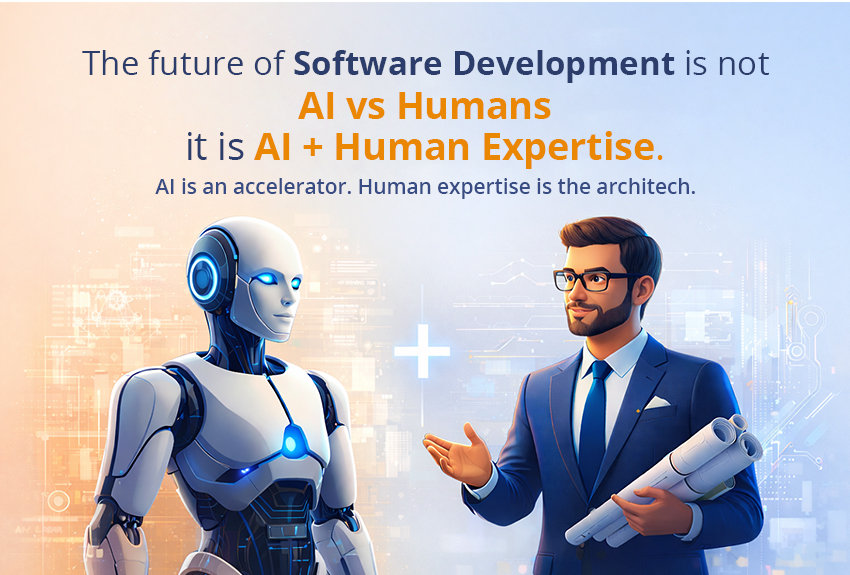
The most effective approach in 2026 is a hybrid development model — where AI tools assist developers with routine tasks, while experienced engineers design system architecture and ensure code quality and security.
Note: Productivity gains vary significantly by developer experience, codebase familiarity, and how well the organization structures its AI usage. Organizations without clear AI governance see little measurable improvement.
Advantages of the Hybrid Approach
- Faster development timelines and lower time-to-first-PR for new team members
- Reduced repetitive coding tasks, freeing engineers for complex problem-solving
- Higher productivity for mid-level and junior developers navigating new codebases
- Strong engineering oversight and architecture control where it counts most
- Reliable, scalable systems designed for long-term performance
How OpenSource Technologies Supports Both Approaches
At OpenSource Technologies, we understand that every business has different technology needs. Some clients want to adopt AI-driven development workflows; others require traditional development methods due to compliance, security, or internal policies. Our flexible development model supports both.
AI-Assisted Development — For Rapid Innovation
For clients who want to leverage AI-powered development, our teams use modern AI tools to accelerate cycles, automate routine programming tasks, improve testing and debugging, and prototype new features quickly. This approach also supports AI software development services in the mobile space — including artificial intelligence in mobile app development, where AI can accelerate feature prototyping, personalize user experiences, and automate repetitive build tasks. This approach is ideal for:
- Startups and SaaS platforms that need to move fast and iterate often
- Product teams prototyping new features or MVPs
- Development sprints where reducing boilerplate is a strategic priority
- Greenfield projects with flexible architecture requirements
- Mobile app teams leveraging artificial intelligence in mobile app development for smarter, faster iteration
Traditional Manual Coding — For Precision and Control
For organizations that prefer full control over the development process, we provide traditional software engineering services without relying on AI-generated code. Manual coding ensures:
- Maximum transparency and auditability of every line of code
- High security standards — critical when AI-generated code carries known vulnerability risk
- Custom-built architectures designed from first principles
- Development practices aligned with industry regulations — including HIPAA, GDPR, and SOC2 requirements — even where formal certification is held by the client or their auditors.
Industries including healthcare, finance, and government frequently require this level of precision. While OST does not hold HIPAA, GDPR, or SOC2 certifications directly, we build software with the engineering rigor and security practices these environments demand — working alongside your compliance and legal teams to meet their requirements.
Real Estate Platforms: A Practical Example
One industry where the tension between AI-powered development and manual engineering is most visible is real estate technology. The PropTech sector is one of the fastest-growing segments of the global technology market.
Where AI Adds Immediate Value in Real Estate
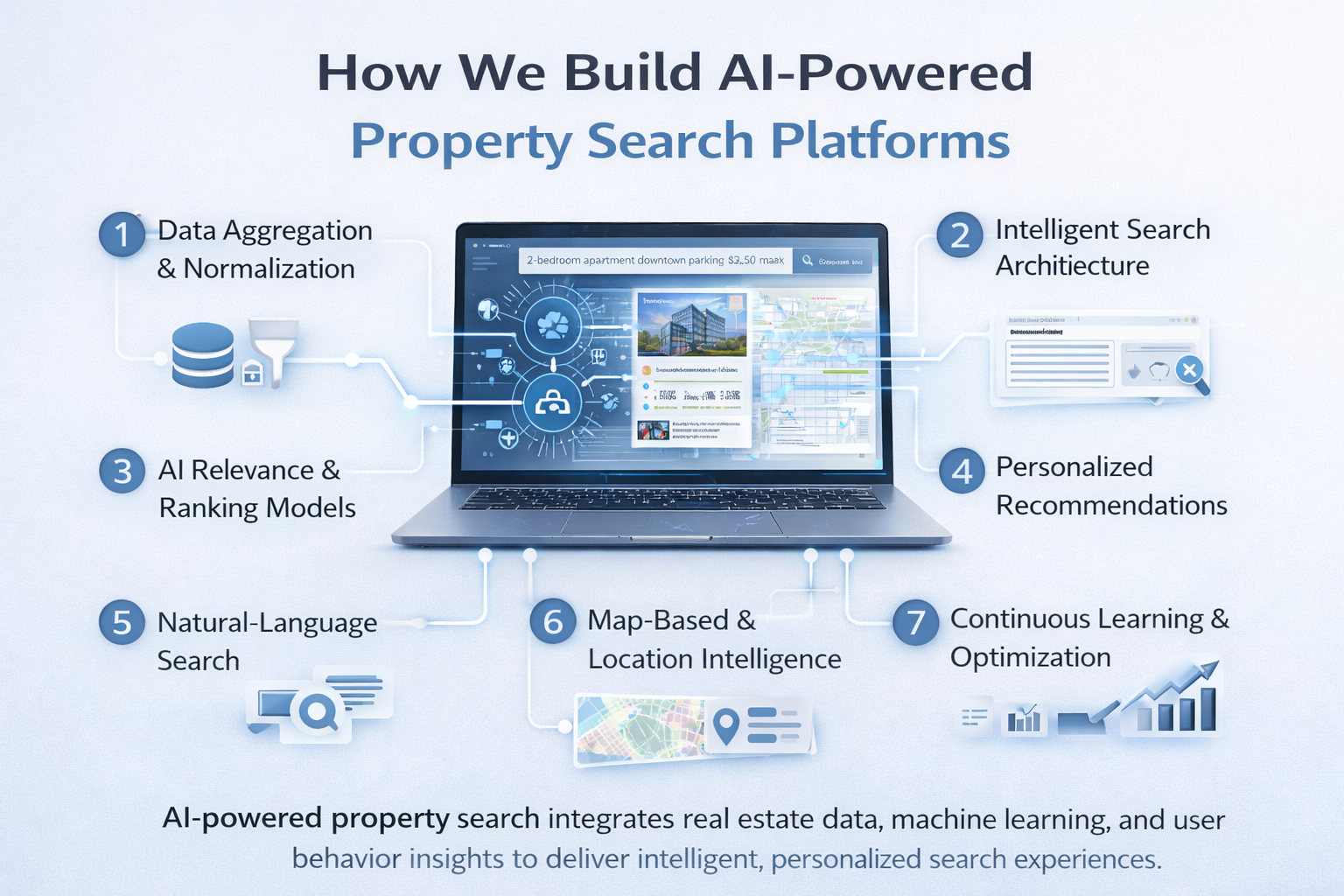
- Intelligent property search and personalized recommendations based on user behavior
- Automated lead scoring to help brokers prioritize high-intent buyers
- Predictive analytics for investment trends and property valuations
- AI-powered chatbots and virtual assistants for 24/7 customer support
- Generative AI for virtual staging, property descriptions, and marketing copy
The intelligent features above are only as reliable as the platform infrastructure beneath them. Core systems in real estate require careful, expert-driven architecture:
- MLS data source integrations with consistent, real-time synchronization
- CRM systems for agents handling sensitive buyer and seller data
- Transaction management tools operating under legal and compliance constraints
- Property analytics dashboards with accurate, auditable data pipelines
- Secure document management platforms for contracts, escrow, and title
At OpenSource Technologies, we have experience building custom real estate platforms that combine intelligent AI features with stable, scalable software infrastructure — ensuring neither speed nor reliability is sacrificed.
Choosing the Right Approach for Your Business
The data is clear: AI development tools are powerful, widely adopted, and here to stay. But the research is equally clear that they are not a silver bullet. AI works best when paired with disciplined engineering, clear governance, and human oversight.
Key Questions to Guide Your Decision
- Is your codebase greenfield or an established legacy system?
- Do you operate under HIPAA, GDPR, SOC2, or similar regulatory frameworks?
- How mature is your internal code review and QA process?
- Are your primary constraints around speed-to-market or long-term maintainability?
- What is your organization’s risk tolerance for security vulnerabilities in generated code?
💡 OST’s Approach: Flexible by Design
→ We assess each engagement on its merits — not on a one-size-fits-all methodology.
→ For speed-focused projects, we integrate proven AI tools into a well-governed development workflow.
→ For compliance-sensitive or security-critical builds, we deliver fully manual engineering with complete auditability — supporting teams operating under HIPAA, GDPR, or SOC2 requirements.
→ For most enterprise clients, we recommend a hybrid model — AI where it accelerates, human expertise where it protects.
Final Thoughts
AI is genuinely transforming software development. In 2026, nearly 93% of developers use an AI assistant regularly, and over a quarter of all production code is AI-authored. But the productivity paradox is real: organizations that adopt AI without structure, governance, or experienced engineers to oversee output often see bugs increase, delivery stability decrease, and technical debt accumulate.
The winning strategy is not choosing AI or manual coding. It is choosing when to use each — and having a technology partner with depth in both. Whether you need cutting-edge AI software development services, or the application of artificial intelligence in mobile app development for your next product launch, the right partner makes all the difference.
At OpenSource Technologies, we help businesses navigate this evolving landscape. Whether a project requires rapid AI-driven innovation, strict engineering control, or a carefully calibrated hybrid approach, our teams deliver reliable software solutions designed for long-term success.
By combining intelligent automation with expert engineering, OpenSource Technologies enables businesses to build technology platforms that are modern, efficient, secure, scalable, and future-ready.