The Revolution Is Already Here
If you’ve searched for a property online recently, been quoted a rent price, or received a recommended listing that felt almost eerily relevant — you’ve already experienced AI in real estate. What once required weeks of manual research, stacks of documents, and dozens of phone calls can now be done in hours. AI is no longer a futuristic concept in the real estate industry; it’s an operational reality reshaping how properties are found, valued, financed, and managed.
The numbers reflect this transformation. The global AI in the real estate market grew from $222.65 billion in 2024 to an estimated $303.06 billion in 2025, a compound annual growth rate (CAGR) of 36.1%. By 2029, the market is projected to reach $988.59 billion. This is not incremental change — it is a full-scale industry reinvention.
For brokerages, investors, property managers, and buyers alike, understanding how AI is changing the game is no longer optional. Here’s a deep dive into the most impactful applications — and the data behind them.
$303B
AI Real Estate Market (2025)
36.1%
Annual Growth Rate (CAGR)
$989B
Projected Market Size by 2029
1. Intelligent Property Search: Finding the Right Property Faster
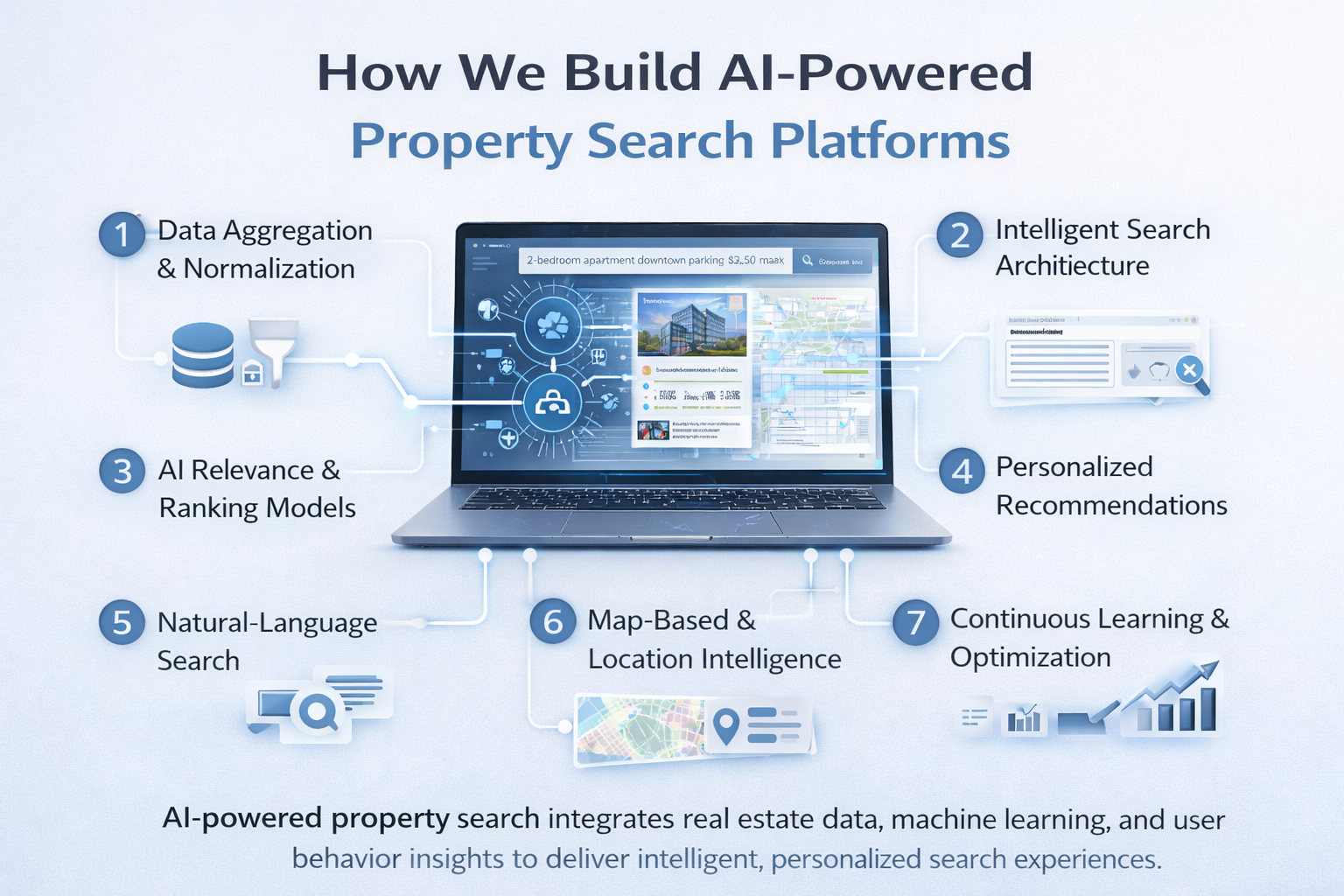
The old way of searching for real estate was blunt: filter by price, beds, baths, zip code. The new way is conversational, contextual, and deeply personalized. AI-powered search engines now interpret intent rather than just keywords. A query like “quiet neighborhood near good schools with a home office” is understood — not just parsed.
Today, forward-thinking firms are investing in efforts to Build AI-Powered Property Search Platforms that go far beyond basic filters. Platforms powered by natural language processing (NLP) surface listings based on behavioral data, past interactions, and real-time market availability. AI can also make smart “similar listing” suggestions, nudging users toward properties they may not have considered but are likely to love.
- AI-powered chatbots enhance lead generation in real estate by up to 33% (Precedence Research)
- Virtual staging enhanced by AI increases property inquiries by up to 200% vs. traditional methods
- 85% of real estate agents using AI report meaningful time savings (All About AI, 2025)
2. Automated Document Extraction: Eliminating the Paper Mountain
Commercial real estate has long been buried in documents — Offering Memorandums, rent rolls, lease agreements, financial statements, inspection reports. AI is finally tackling this paper mountain at scale.
Using machine learning and optical character recognition (OCR), AI tools can extract structured data from unstructured documents in seconds. A 200-page OM that would take an analyst half a day to review can be digested and summarized in minutes. Key financial figures, lease terms, escalation clauses, and tenant covenants are automatically pulled and organized.
- Faster property onboarding and deal evaluation
- Reduced manual data entry and human error
- Structured, comparable financial data across portfolios
74% of property management companies already use AI for task automation, and document processing is one of the highest-impact areas (All About AI, 2025).
3. Real-Time Portfolio Analytics: The Always-On Dashboard
Managing a real estate portfolio used to mean waiting for monthly reports, manually pulling together data from disconnected systems, and making decisions based on yesterday’s numbers. AI-powered dashboards have changed all of that.
Modern Real Estate Development Management Software platforms provide live visibility into NOI performance, vacancy trends, rent collection rates, deal pipelines, and agent productivity — all in one place, updated in real time. Anomalies are flagged automatically. Underperforming assets are surfaced before they become problems.
The result? Brokerages and asset managers can make faster, more confident decisions — without needing to wait for a report that’s already out of date. JLL’s 2024 Future of Work Survey found that 90.1% of companies expect to conduct their corporate real estate activities with AI supporting human experts within five years, and over 60% have already begun piloting AI use cases.
4. Predictive Market Analytics: From Reactive to Proactive
Perhaps the most powerful application of AI in real estate is its ability to look forward. By analyzing historical transaction data, macroeconomic indicators, demographic trends, and local market signals, AI models can predict where prices are heading, which neighborhoods are appreciating, and which asset classes carry the most risk.
- AI tools can predict property price trends with up to 95% accuracy (Precedence Research)
- AI-powered property management platforms can boost rental income by up to 9% while cutting maintenance costs by 14% (All About AI)
- Properties marketed with AI-driven tools saw a 22% increase in sales performance (All About AI, 2025)
For investors and brokers, this translates directly to competitive advantage — identifying high-potential opportunities earlier, pricing assets more accurately, and exiting positions at the right time.
5. Deal Pipeline & Brokerage Intelligence
Running a brokerage has always required juggling leads, deals, agents, and clients simultaneously. AI is bringing order to this complexity. Machine learning models now score and prioritize leads based on behavioral signals, helping brokers focus their energy on the prospects most likely to convert.
AI also enables deal stage forecasting — predicting which transactions are likely to close, which may fall through, and what the revenue pipeline looks like for the next quarter. Combined with agent productivity analytics, brokerage leaders gain an unprecedented level of operational clarity.
AI is set to drive 38% of efficiency savings in real estate by 2030, generating over $40 billion annually for the global commercial sector (All About AI). McKinsey estimates AI could add over $180 billion in value to the real estate field every year.
6. AI-Powered Property Management Software: Smarter Buildings, Happier Tenants
The tenant experience — from application to lease renewal — is being reimagined through AI-Powered Property Management Software. Automated tenant screening systems analyze credit profiles, income verification, and rental history in minutes. AI-powered communication tools handle routine inquiries, maintenance requests, and lease renewal nudges without requiring property manager intervention.
The rise of dedicated Property Management Software Development has made these capabilities accessible to organizations of all sizes — from boutique firms managing a handful of units to institutional operators overseeing thousands of properties across multiple markets.
- AI is predicted to reduce time spent on tenant screening by 75% (All About AI, 2025)
- AI-driven property management platforms cut maintenance costs by up to 14%
- Automated communication platforms significantly improve tenant satisfaction and retention scores
7. The PropTech Ecosystem Is Growing Fast
The infrastructure supporting AI in real estate is expanding rapidly. According to JLL Research, as of the end of 2024, among 7,000 global PropTech companies, approximately 10% — or 700 companies — are providing AI-powered solutions. Around 62% of these firms are venture capital-backed, and 83% are already generating revenue or profitable, signaling strong long-term market viability.
North America leads this charge. In 2024, North America commanded a 38.5% market share in AI real estate, contributing over 41% of global revenue. Private AI investment in the US alone hit $109 billion in 2024 — double the 2023 figure.
The PropTech market itself is forecasted to grow from $34 billion in 2023 to $90 billion by 2032, with AI-powered solutions representing the fastest-growing segment (Fortune Business Insights).
8. What’s Next: The Future of AI in Real Estate
The applications we see today are just the beginning. As AI models become more capable and real estate data ecosystems become more integrated, the next wave of innovation is already taking shape:
- Automated investment underwriting — AI that can evaluate an acquisition opportunity end-to-end
- AI-driven property valuation at scale — replacing or augmenting traditional appraisal processes
- Hyper-local market forecasting — neighborhood-level predictions using satellite imagery, foot traffic, and economic data
- Intelligent brokerage platforms — fully integrated systems that manage leads, deals, documents, and analytics in one AI-powered environment
JLL’s research notes that AI has enormous potential to reshape real estate, with near- and long-term impacts ranging from new markets and asset types to innovations in investment and revenue models. Organizations that begin piloting AI applications now will be far better positioned to scale strategically as the technology matures.
The Bottom Line
Real estate has historically been one of the slowest industries to embrace technology. That era is over. AI is transforming every layer of the business — from the moment a buyer types a search query to the day a lease is renewed years later.
The firms winning in this new environment are not those with the most properties or the most agents — they’re the ones that have learned to harness data, automate intelligently, and let AI handle the volume so their people can focus on relationships, strategy, and execution. Whether through investing in Property Management Software Development, choosing to Build AI-Powered Property Search Platforms, deploying Real Estate Development Management Software, or implementing AI-Powered Property Management Software — the organizations acting now are positioning themselves to lead.
With the AI in the real estate market on track to exceed $988 billion by 2029, the question is no longer whether to adopt AI — it’s how fast you can get there.