Commercial Real Estate (CRE) brokerages process a high volume of Offering Memorandums (OMs) every month. These documents contain essential property, financial, and lease data — but extracting and structuring this information manually is time-consuming, repetitive, and prone to error.
AI-powered OM automation changes that.
This article explains:
- How Many OMs Does a Brokerage Firm Actually Process?
- How AI OM automation works step-by-step
- How OM automation improves compliance & data consistency
- What to look for in an OM automation platform
- How AI reduces underwriting bottlenecks
By the Numbers
How Many OMs Does a Brokerage Firm Actually Process?
The volume is staggering — and it scales dramatically with firm size. Based on industry data and platform benchmarks:
20–40 OMs processed per month at a small brokerage (1–5 brokers) actively working multiple listings and reviewing buy-side opportunities.
Industry benchmark estimate
100–300 OMs processed monthly at a mid-sized brokerage (10–25 agents), combining listing creation, buyer analysis, and market comp review.
Industry benchmark estimate
500+ OMs processed per month at large institutional brokerages with multiple offices, active pipeline, and nationwide deal flow.
DealGround: 250+ OMs ingested/day on automated platforms
Industry benchmark estimate
To put this in perspective, the U.S. CRE market saw over 93,000 property transactions in the first three quarters of 2025 alone. Each transaction typically generates multiple OMs at various stages of marketing and due diligence. Aggregate CRE transaction volume reached $265 billion through Q3 2025 — and every deal behind those numbers required document processing. At a mid-sized brokerage reviewing 150 OMs per month, and spending even a conservative 4–6 hours manually extracting and entering data per document, that’s 600 to 900 staff-hours lost every single month to work that AI can now handle in minutes.
What Is Automated OM-to-Property Creation?
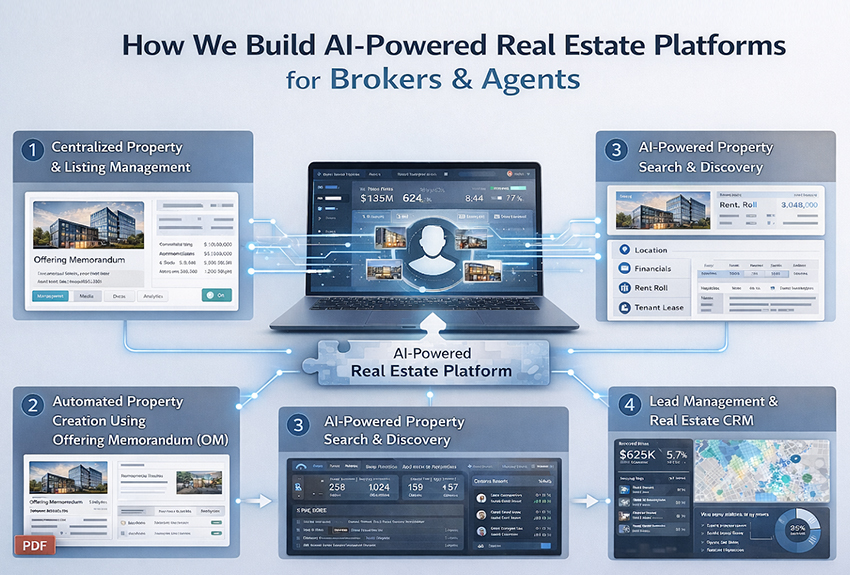
Automated OM-to-property creation is an AI-powered workflow that transforms unstructured PDF offering memorandums into clean, structured property records — automatically, at scale, and without human intervention in the data extraction layer.
Instead of an analyst opening a PDF and manually copying rent roll data, NOI figures, lease expirations, and property details into a CRM or spreadsheet, the AI system reads the document, identifies relevant fields, interprets context (the way a CRE professional would), and populates a structured property record — all within seconds.
How It Works
The Automated OM-to-Property Workflow — Step by Step
1) OM Ingestion — Seamless Document Intake
Offering Memorandums are collected through secure digital channels or uploaded directly into the system by authorized users.The system automatically receives and organizes incoming OMs, regardless of format or volume, ensuring consistent intake without manual sorting or document handling.
2) AI Document Classification & Section Recognition
Once received, the AI reads the entire document and intelligently identifies its structure.
It automatically recognizes key sections such as:
- Executive summary
- Rent roll
- Operating statements
- Lease abstracts
- Market analysis
This eliminates the need for manual file labeling or template matching.
3) Automated Data Extraction
The AI extracts and structures key property and financial data automatically, including:
- Property address and asset class
- Total square footage
- Year built
- Number of units or tenants
- Individual lease terms
- Rent per square foot
- Net Operating Income (NOI)
- Cap rate
- Asking price
- Market comparables
Unlike basic text-scanning tools, the system understands context — interpreting financial meaning the way a CRE analyst would.
4) Cross-Document Validation & Error Detection
The system reconciles financial figures across all related documents in the deal package.
If discrepancies appear — for example, if the rent roll total does not match the stated income in the financial summary — the system flags the issue immediately.
This early validation reduces the risk of costly errors being discovered during late-stage due diligence.
5) Automatic Property Record Creation
Once validated, clean and structured data is automatically pushed into the brokerage’s CRM, deal management system, or financial modeling tools.
Property records are created with:
- Full rent roll
- Lease abstracts
- Financial summaries
- Structured property details
Within minutes, the property is ready for listing, underwriting, or internal analysis.
6) Analyst Review & Deal Analysis
Brokers and analysts receive structured, review-ready data instead of raw PDF documents.
Their time is focused entirely on:
- Underwriting
- Scenario modeling
- Risk analysis
- Investment decision-making
Human expertise shifts from data entry to strategic evaluation.
Business Impact
Why Faster Property Onboarding Creates Competitive Advantage
In commercial real estate, speed directly influences deal flow and revenue. In Q3 2025 alone, over 45,000 commercial properties transacted across the U.S. market. In a competitive environment like this, the ability to evaluate, underwrite, and respond to opportunities faster than competitors determines who wins mandates and closes deals.
Faster property onboarding is not just operational efficiency — it is strategic positioning.
-
For Listing Brokers
Automated OM-to-property creation enables a newly signed listing to be structured, analyzed, and prepared for marketing within hours.
With AI-structured data:
- Financial summaries are ready immediately
- Rent rolls are digitized and standardized
- Investor-ready data rooms can be populated faster
- Property marketing workflows begin sooner
Traditionally, preparing a listing for the market may take a good amount of time due to manual data entry and formatting. Automation compresses that timeline significantly, allowing brokers to launch properties faster and respond to investor inquiries with structured financial data immediately.
Speed enhances credibility and strengthens client relationships.
-
For Acquisition Teams & Investors
Acquisition teams often receive dozens of OMs per month. The bottleneck is rarely decision-making — it is data gathering.
Manual workflows require:
- Extracting financial tables
- Reconciling rent roll totals
- Validating NOI calculations
- Formatting underwriting models
In many mid-sized firms, underwriting a single deal can span multiple days, with a substantial portion of that time spent on document processing rather than analysis.
AI automation shifts the focus:
- OMs are processed within minutes
- Financial data is structured automatically
- Analysts begin underwriting immediately
This reduces evaluation timelines dramatically and enables firms to assess more opportunities without expanding headcount.
-
For Operations & Compliance
Standardized, AI-structured property data ensures:
- Consistent financial reporting across portfolios
- Centralized rent roll storage
- Uniform lease abstraction formats
- Traceable audit history
Manual processes create inconsistencies across spreadsheets and teams. Structured automation ensures that portfolio-level analytics and compliance reporting remain accurate and scalable.
-
For Competitive Positioning
Commercial real estate has historically relied on manual document workflows. Firms that adopt OM automation gain measurable advantages:
- More deals evaluated per quarter
- Faster investor response times
- Reduced operational overhead
- Analysts focused on judgment, not transcription
Speed compounds. The more efficiently a firm processes opportunities, the more capacity it builds over time.
Getting Started
What to Look For in an OM Automation Platform
Not all document processing systems are built for commercial real estate. Generic tools often extract text without understanding CRE financial structure.
When evaluating solutions, firms should prioritize:
- CRE-Native Intelligence: The system must understand rent rolls, NOI structures, lease abstracts, and offering memorandum conventions — not just convert PDFs into text.
- Financial Model Integration:- Extracted data should integrate directly into underwriting tools, CRM systems, and portfolio dashboards without manual re-entry.
- Bulk Processing Capability:- The platform should handle high-volume ingestion (50–500 OMs per month) while maintaining accuracy and processing speed.
- Accuracy & Validation Controls:- Cross-document reconciliation, discrepancy flagging, and confidence scoring ensure data reliability before investment decisions are made.
Final Perspective
The Brokerage of Tomorrow Is Built on Structured Data
Commercial real estate firms that invest in structured data infrastructure gain a measurable operational advantage.
Automated OM-to-property creation enables:
- Significant time savings
- Faster listing activation
- Improved underwriting efficiency
- Higher deal evaluation capacity
- Stronger portfolio analytics
For mid-sized firms, the productivity recovery alone can represent hundreds of hours annually — allowing teams to evaluate more opportunities and respond to the market with greater agility.
The technology is available. The strategic question is not whether automation is beneficial — it is how quickly firms implement it to remain competitive.
Final Takeaway
Automated OM-to-property creation powered by AI reduces document processing time by up to 90%, saves more than 1,200 operational hours annually for mid-sized CRE firms, and creates a scalable, data-driven brokerage infrastructure.
In modern commercial real estate, OM automation is not a convenience — it is operational efficiency at scale.