SEO-optimized, AI-ready deep dive
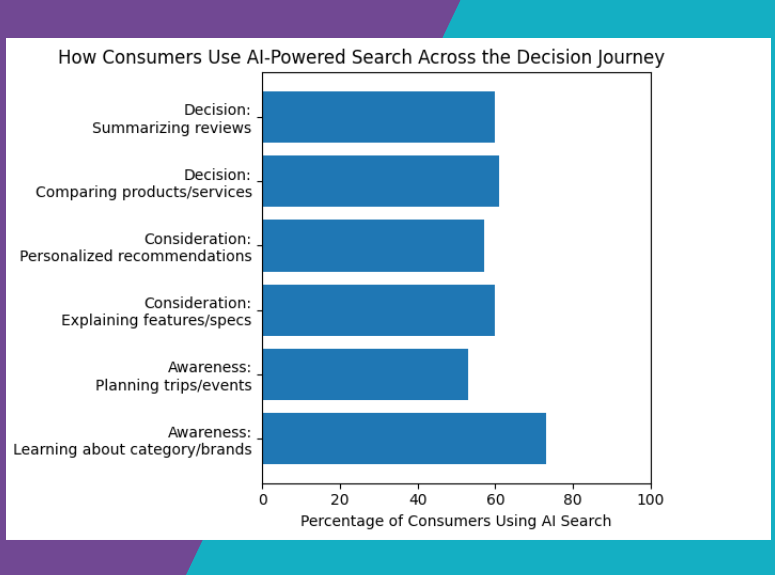
Search behavior is changing faster than at any point in the last decade. Research from McKinsey & Company indicates that around 50% of consumers already use AI-powered search tools to answer everyday questions. This major shift is redefining how people discover, evaluate, and trust information online—and it fundamentally changes how businesses must approach AI SEO and content strategy.
AI is no longer an emerging trend in search. It is already shaping how users expect answers to be delivered.
Why People Are Turning to AI Search
Traditional search engines often require effort: users type a query, scan multiple links, compare sources, and piece together answers themselves. AI-powered search simplifies this process by delivering responses that are faster, more conversational, and contextually aware.
Real data shows this shift isn’t hypothetical — it’s already happening:
- Users find AI search more efficient. A recent survey found that 83 % of respondents believe AI-powered search tools are more efficient than traditional search engines because they provide cohesive, ready-to-use answers without clicking through multiple links.
- AI search is becoming a habitual habit. Around 43 % of consumers now use AI search tools daily, and three-quarters report using them more often than a year ago, indicating that AI isn’t just an experiment — it’s becoming part of everyday digital routines.
- A growing share start their searches with AI. In a recent study, 37 % of people said they begin new information searches with AI tools rather than traditional search engines—a clear sign of shifting user behavior.
These trends reflect why users increasingly turn to AI search:
- Direct, summarized answers
Users get a clear response without visiting multiple pages.
- Context-aware responses
AI understands follow-up questions and intent, not just keywords. - Conversational experiences
Search feels more like a dialogue than a list of links. - Faster decision-making
Answers arrive in seconds, often with actionable recommendations.
For example, instead of searching “best safety compliance software” and opening five different websites, users now ask an AI platform a single question and expect one accurate, trustworthy answer. The platform becomes the decision layer.
Is Traditional SEO Dead?
No—but it has evolved significantly.
SEO is no longer just about ranking blue links on a results page. With the rise of AI-powered search and generative answers, visibility now depends on how well search engines and AI systems understand, trust, and interpret your content.
Today, Search Engines and AI Platforms prioritize:
- Fast-loading, mobile-responsive websites
AI and search engines favor websites built by a professional website development company, with fast load times, mobile responsiveness, and strong Core Web Vitals—improving usability, trust, AI visibility, and engagement across devices. - Clear, structured, authoritative content
AI relies on well-organized information to extract accurate answers. Pages with clear headings, logical flow, and concise explanations are more likely to be referenced in AI-generated responses. - User intent and meaning over keyword repetition
AI models analyze context, not just keywords. Content that answers real questions, solves problems, and matches search intent performs better than pages optimized only for keyword density. - Schema markup and structured data
Structured data helps AI and search engines clearly ide78ntify what your content represents—whether it’s an article, FAQ, product, service, or organization—improving inclusion in AI summaries and rich results. - Trust signals and real expertise (E-E-A-T)
AI systems favor content backed by experience, accuracy, and credibility. Original insights, case studies, expert opinions, and fact-checked information strengthen trust and visibility. - Topical authority instead of single-page optimization
SEO has shifted from optimizing individual pages to building authority around entire topics. Interlinked, in-depth content clusters help AI understand your expertise holistically. - Visibility beyond clicks
Websites that are not optimized for AI understanding risk losing visibility—even if they rank on page one. When AI delivers answers directly, ranking alone does not guarantee discovery unless your content is selected as a trusted source.
In short, modern SEO is no longer about gaming algorithms. It’s about helping AI accurately understand your business, content, and expertise—so your brand remains visible wherever users search for answers.
How to Make Your Website AI-Search Friendly
(What Content AI Prefers)
AI platforms favor content that is easy to understand, reliable, and well-structured. Specifically, AI prefers content that is:
- Based on first-hand experience and real data- Practical insights outperform generic summaries.
- Supported by specific examples and use cases- Real-world context helps AI validate accuracy.
- Written in a consistent brand voice- Clarity and consistency improve interpretation.
- Fact-checked with credible sources- Accuracy builds trust—for both AI and users.
- Scannable and structured- Headings, bullet points, short paragraphs, and clear sections matter.
AI can draft content quickly, but human expertise creates authority. Original insights, case studies, and expert analysis are what differentiate high-performing content from average content.
The Rise of Generative AI SEO
As AI-powered search grows, Generative AI SEO is becoming essential. To stay competitive, businesses must align with these principles:
- Write for clarity and intent, not just keywords
- Implement schema markup (Article, FAQ, Organization, Product/Service)
- Build topical authority through strong internal linking
- Maintain unique, non-duplicated multilingual content
- Ensure solid crawlability and indexing foundations
Modern SEO is no longer about gaming algorithms. It is about helping AI understand your business, services, and expertise accurately.
Final Takeaway
With 50% of consumers already using AI-powered search, search behavior has clearly changed—and it’s not going back. Generative AI is the future of SEO, reshaping how information is discovered, summarized, and trusted.
Brands that adapt early will gain visibility across:
- Traditional search engines
- AI-powered discovery platforms
- Conversational and voice-based search
Those that don’t risk being left out of the conversation entirely, even if their website technically “ranks.”
The future of SEO belongs to businesses that are AI-ready, intent-driven, and trust-focused.